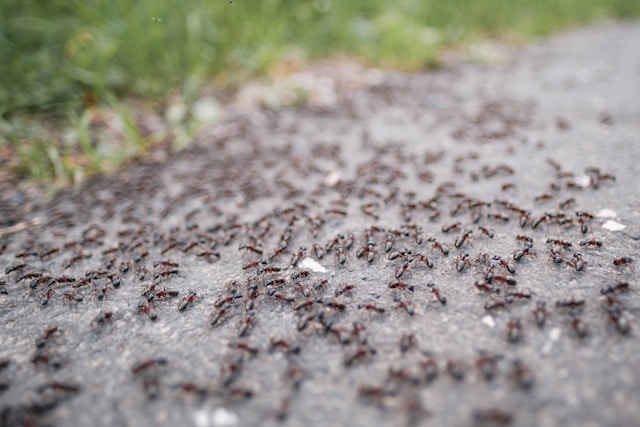
You’ve found ants in your kitchen. Or maybe along your foundation. Or worse, trailing through a rotting windowsill. Before you reach for a can of spray, there’s one thing that matters more than anything else: knowing which ant you’re dealing with.
In Washington State, different ant species require completely different treatment approaches. What works on odorous house ants will do nothing for a carpenter ant infestation, and confusing the two is one of the most common reasons DIY ant control fails. Here’s a breakdown of the most common ants in the Pacific Northwest, how to identify them, and what their presence in your home actually means.
Key Takeaways for Washington Homeowners
- Carpenter ants are the most destructive ant in Washington State. They don’t eat wood, but they excavate it, causing structural damage over time.
- Odorous house ants are the most common ant you’ll find in your kitchen. They’re a nuisance, not a structural threat.
- Moisture is the common thread. Most ant problems in Western Washington are linked to dampness, leaks, or wood rot.
- Fire ants are not established in Washington State. If you’re seeing red ants, they’re likely pavement ants or another species.
Carpenter Ants (Camponotus modoc & related species)
Size: Large, at 1/4 to 1/2 inch long
Color: Black, or black with a reddish-brown midsection
Where you’ll find them: Rotting wood, moisture-damaged walls, under decks, in crawl spaces
Carpenter ants are the species Willard’s gets the most calls about, and for good reason. They’re the largest ant in Washington State and the most damaging. Unlike termites, carpenter ants don’t eat wood. Instead, they tunnel through it to build their galleries, hollowing out beams, window frames, and subflooring from the inside out.
Western Washington’s wet climate makes homes here especially vulnerable. Any wood that’s been exposed to moisture, whether from a leaking gutter, a poorly sealed crawl space, or a damp deck post, is an open invitation. If you’re seeing large black ants inside your home in the spring, especially near windows, doors, or the kitchen, a carpenter ant colony is likely already established nearby.
According to Washington State University Extension, carpenter ants are among the most economically damaging pests in the Pacific Northwest, largely because infestations often go undetected for months or years.
Warning sign: Finding frass, which is a mixture of sawdust-like wood shavings and insect debris, near baseboards or in your crawl space is a strong indicator of an active infestation.
Odorous House Ants (Tapinoma sessile)
Size: Small, at 1/16 to 1/8 inch long
Color: Dark brown to black
Where you’ll find them: Kitchens, bathrooms, along baseboards, near moisture
If you’ve crushed a small ant and noticed a smell like rotten coconut or blue cheese, you’ve found an odorous house ant, the most common indoor ant in Washington State. These ants are relentless foragers and will trail into your home chasing sugary foods, pet water bowls, or virtually any moisture source.
The good news is that odorous house ants don’t cause structural damage. The frustrating news is that their colonies can contain hundreds of thousands of workers spread across multiple nesting sites, which makes over-the-counter bait traps largely ineffective. Treating one trail rarely resolves the problem.
The Pacific Northwest Pest Management Handbook notes that odorous house ants are particularly difficult to control because colonies readily split and relocate when disturbed, a process called budding.
Pavement Ants (Tetramorium immigrans)
Size: Small, at about 1/8 inch long
Color: Dark brown to black, with lighter legs
Where you’ll find them: Cracks in driveways, sidewalks, under slabs, along foundations
Pavement ants are exactly what they sound like. They nest in the cracks of pavement, concrete slabs, and along the base of foundations. You’ve almost certainly seen their sandy mounds pushed up between sidewalk joints. While they mostly live outside, they’ll forage indoors for food, especially greasy or sweet items.
They’re often confused with odorous house ants, but pavement ants have a slightly broader body and parallel grooves (striae) on their head and thorax that are visible under magnification.
Moisture Ants (Lasius sitiens & related species)
Size: Small to medium, at 1/8 to 1/4 inch long
Color: Yellow to light brown
Where you’ll find them: Crawl spaces, bathrooms, near plumbing leaks, in rotting wood
Moisture ants are a Washington specialty, and our climate is practically tailor-made for them. Unlike carpenter ants, moisture ants only nest in wood that is already decayed. Finding them in your home isn’t just a pest problem; it’s a warning sign of an underlying moisture issue that needs to be addressed.
Homeowners often discover moisture ant colonies during crawl space inspections or bathroom renovations. While the ants themselves aren’t the primary threat, ignoring them typically means ignoring the rot, mold, or plumbing leak that brought them there in the first place.
Velvety Tree Ants (Liometopum occidentale)
Size: Small to medium, at 1/8 to 1/4 inch long
Color: Black abdomen with a reddish-brown head and thorax
Where you’ll find them: Forested areas, tree stumps, bark, occasionally structural wood
Velvety tree ants are common in wooded parts of King, Snohomish, and Kittitas counties. They nest inside dead or dying wood and occasionally move into structures, especially homes surrounded by mature trees. They look somewhat similar to carpenter ants but are smaller and have a distinctly velvety texture to the abdomen.
They can bite when disturbed and emit a distinctive, unpleasant formic acid odor, which is another reason proper identification matters before treatment.
What About Fire Ants in Washington State?
This is one of the most common questions we hear: are there fire ants in Washington State?
The short answer is no, not in any established way. The red imported fire ant (Solenopsis invicta) has not colonized Washington State, and our cool, wet climate makes establishment difficult. If you’re seeing small reddish ants, you’re most likely dealing with pavement ants, moisture ants, or occasionally a species of red harvester ant in the drier eastern regions of the state.
European fire ants (Myrmica rubra) are a different story. They have been found in small pockets around the Puget Sound region and are an invasive species of concern tracked by the Washington State Department of Agriculture. They’re small, reddish-brown, and do sting, but they’re not the same species most people picture from the southeastern U.S.
When to Call a Professional
If you’re seeing large black ants inside your home, especially in early spring, or if you’ve noticed frass, soft spots in wood, or an ant trail you can’t seem to eliminate, it’s time to call a professional.
DIY treatments can suppress visible activity without addressing the colony, the moisture source, or the structural entry points that keep ants coming back. Willard’s Pest Control serves King, Pierce, Snohomish, and Kittitas counties with targeted ant control that treats the source, not just the symptom.
Contact Willard’s Pest Control or give us a call at 425-820-1980 (West) or 509-962-2044 (Kittitas) and let’s figure out what’s going on.